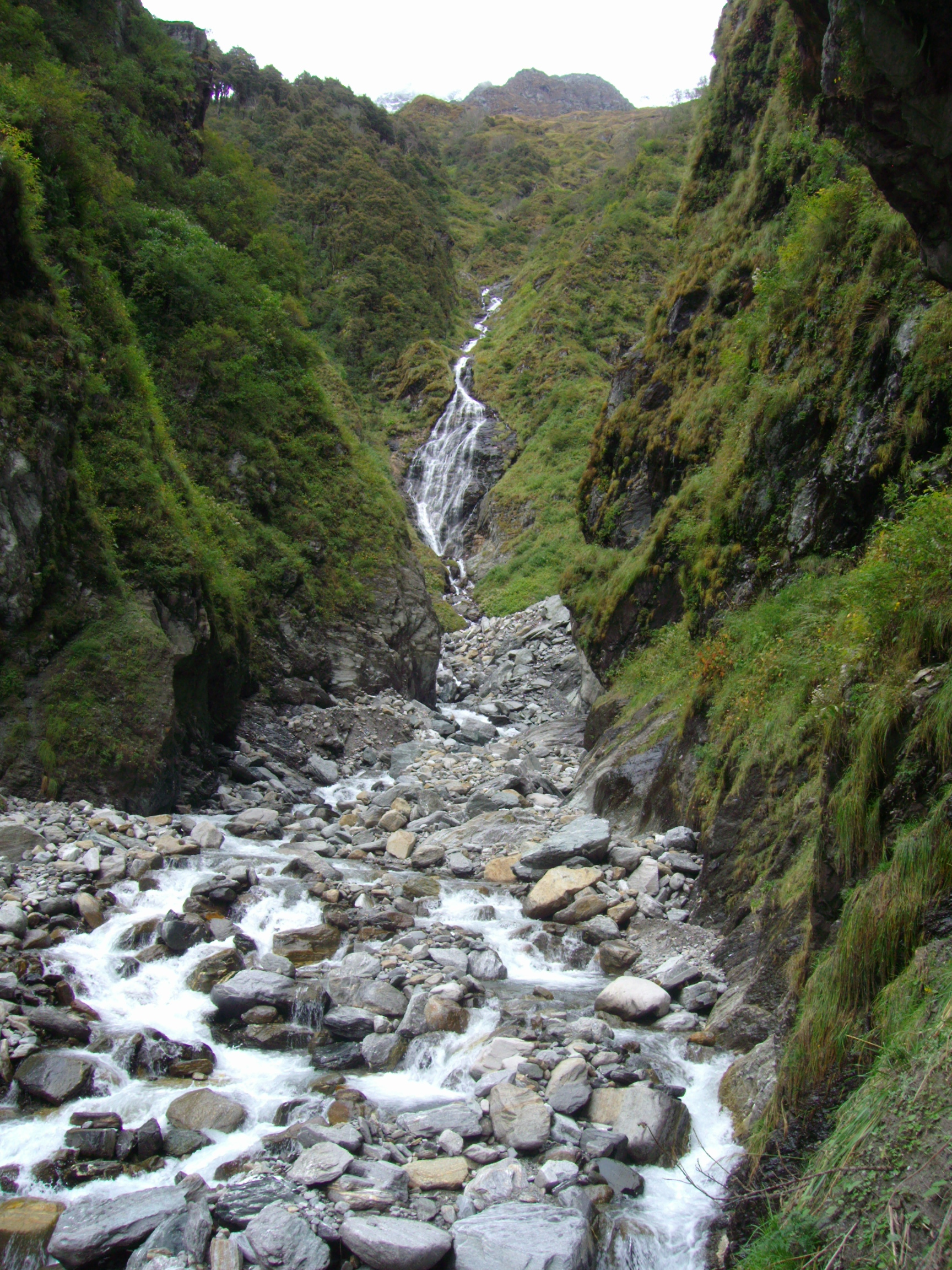
The Yamuna's shrine, where rice cooks in a hot spring
Yamunotri is the shrine of the goddess Yamuna at about 3,293 m below Bandarpunch, the westernmost of the Char Dham and usually the first on the circuit. It is a walk of about 6 km from the road head at Janki Chatti, with hot springs at the temple. Most pilgrims base at Barkot or Janki Chatti for 1–2 nights.
Altitude
3,293 m
Best months
May – Jun · Sep – Oct
Nights
1–2
Position
31.01° N, 78.46° E
Photo: Atarax42 · CC BY-SA 3.0 · Commons
Yamunotri sits in a tight gorge at the head of the Yamuna valley, on the flank of the Bandarpunch massif. The river's true source lies higher, at the Champasar and Yamunotri glaciers below Kalind Parvat, which are too steep and dangerous for pilgrims; the temple marks the point where worship has long been offered instead. Destroyed by snow and floods and rebuilt more than once, the temple holds a black stone image of Yamuna, sister of Yama, the god of death.
Beside the temple, hot springs burst from the rock. The hottest, Surya Kund, is hot enough to cook rice and potatoes, and pilgrims lower small cloth bundles into it and carry the cooked grain home as prasad. Before darshan, pilgrims touch Divya Shila, a rock pillar beside the spring, and bathe in Jamuna Bai Kund, a warm pool fed by the springs. In winter the goddess moves down to Kharsali, the village of her priests, across the river from Janki Chatti.
Yamunotri is usually the first stop on a Char Dham circuit, reached by road from Dehradun via Mussoorie or from Rishikesh via Chamba to Barkot, then 45 km more to Janki Chatti. From there a paved path of about 6 km climbs steeply up the gorge. It is the shortest of the walking dhams but steep, and in May and June the path is crowded with ponies and palkis. Start early and allow a full day.
Say it like a local · Garhwali / HindiChatti
pilgrim halt on the old walking route; Janki Chatti and Hanuman Chatti below Yamunotri keep the name
What to do in Yamunotri
The Janki Chatti climb
A paved path of about 6 km, rising some 650 m up the narrow Yamuna gorge past waterfalls and tea stalls. Fit walkers take 2.5–3 hours up. Ponies, palkis and porters carrying pilgrims in baskets crowd the path in peak weeks.
Rice cooked in Surya Kund
Pilgrims tie rice or potatoes in a cloth, lower it into the near-boiling Surya Kund spring beside the temple and wait a few minutes. The cooked grain is offered to the goddess and taken home as prasad. Shops sell ready-made bundles.
Divya Shila and the temple
Before entering the temple, pilgrims worship at Divya Shila, a rock pillar near Surya Kund. Inside, the goddess Yamuna is a black stone image. Darshan is usually quicker than at Kedarnath or Badrinath, but queues build by mid-morning.
Kharsali, the winter seat
A stone-and-timber village across the river from Janki Chatti, where the goddess spends winter and the temple's priests live. Its lanes, terraces and old temples make a quiet walk on the day after your climb.
Bandarpunch views
On clear mornings in May and October the snowy Bandarpunch massif, at over 6,300 m, closes the head of the valley above Janki Chatti and Kharsali. Early light before cloud builds is best for photographs.
Field notes
What most guides miss about Yamunotri
Sourced
The springs beside Yamunotri temple are hot enough to cook rice and potatoes. The temple opens on Akshaya Tritiya and closes on Yama Dwitiya, the second day after Diwali, and has been destroyed by snow and floods and rebuilt more than once.
Source: Yamunotri Temple
Sourced
The Yamuna's actual source is a glacier at about 6,387 m near the Bandarpunch peaks. It is so hard to reach that the shrine was placed at the foot of the hill, and pilgrims offer worship at the temple instead.
Source: Yamunotri
Sourced
Kharsali, home of Yamunotri's priests, hosts the goddess in winter. Around 1830 the village was painted by Charles Bentley, and an engraving of it, The Village of Kursalee, illustrated a poem by Letitia Elizabeth Landon published in 1838.
UTC or private bus, Rishikesh or Dehradun to Barkot₹350–550
Shared jeep seat, Barkot to Janki Chatti₹100–200
Pony, Janki Chatti to Yamunotri (one way)₹1,500–2,500 at notified rates
Palki, Janki Chatti to Yamunotri and back₹6,000–10,000 at notified rates
Double room in Barkot or Janki Chatti, peak₹1,500–4,000
Rice bundle for Surya Kund prasad₹20–50
Local prices change with season and fuel costs. Check current status before you travel.
Getting there
How to reach Yamunotri
Bus
UTC and private buses run from Rishikesh and Dehradun to Barkot, about 6–8 hours, leaving early morning. Shared jeeps and a few buses cover the 45 km from Barkot to Janki Chatti, the road head.
Road
From Dehradun, the shortest drive is via Mussoorie and Kempty Falls to Barkot, about 140 km and 5 hours. From Rishikesh, go via Chamba and Brahmkhal, about 6–7 hours. The last stretch past Syanachatti and Hanuman Chatti is narrow and slide-prone.
Trek
From Janki Chatti, a paved path of about 6 km climbs to the temple. Ponies, palkis and porters run at district-notified rates; book at the official counters and keep the receipt. Check current status before you travel.
Where to stay
Sleeping in Yamunotri
Saver: GMVN runs rest houses on this road, and Barkot, Syanachatti and Janki Chatti have many simple lodges and dharamshalas at ₹500–2,000 a room. Comfort: Barkot has the most comfortable hotels on the route, at ₹2,500–6,000 a double, and most comfort itineraries sleep two nights there, doing Yamunotri as a long day. There is no luxury stay in the Yamuna valley; signature trips begin from Mussoorie the night before.
Drawn by Himalaya Hives from Natural Earth outlines (public domain). Borders as depicted by India. Not for navigation.
Questions
Yamunotri, answered
When does Yamunotri temple open and close?
Yamunotri opens on Akshaya Tritiya, usually in late April or early May, and closes on Yama Dwitiya (Bhai Dooj), two days after Diwali. The goddess then moves to Kharsali. Exact dates are announced each year; check current status before you travel.
How far is Yamunotri from Janki Chatti?
About 6 km by paved path, climbing roughly 650 m. Most walkers take 2.5–3 hours up. Ponies, palkis and porters are available at notified rates. There is no road or helicopter shuttle to the temple itself.
Where should I stay for Yamunotri?
Barkot, 45 km below, has the best range of hotels and suits most travellers. Janki Chatti and Kharsali, at the trailhead, let you start walking earliest but have simpler rooms. Book ahead in May and June.
How do I reach Yamunotri from Dehradun?
Drive or take a bus via Mussoorie and Kempty Falls to Barkot, about 140 km and 5 hours, then 45 km to Janki Chatti. Buses also run from Rishikesh via Chamba. Start early to avoid traffic on the Mussoorie road.
Is Yamunotri the first dham of the Char Dham Yatra?
By tradition the circuit runs west to east: Yamunotri, Gangotri, Kedarnath and Badrinath. Yamunotri is first because it is the westernmost. You can visit in any order, but following the tradition also makes geographic sense from Dehradun or Rishikesh.
Is registration needed for Yamunotri?
Yes. Char Dham registration is mandatory and is checked on the road, often at Barkot or Janki Chatti. Register online or at counters in Rishikesh or Haridwar, and carry the slip or QR code. Check current status before you travel.
Is there mobile network at Yamunotri?
Jio and BSNL usually work at Barkot and Janki Chatti, with patchy coverage on the trek and at the temple. Barkot has ATMs; above it, carry cash for ponies, prasad and food.
Can I visit Yamunotri in a day from Barkot?
Yes, it is a long day: 1.5–2 hours to Janki Chatti, 6–7 hours for the walk and darshan, and the drive back. Leave Barkot by 5 am. Many comfort itineraries do exactly this and sleep two nights in Barkot.
Is Yamunotri safe in the monsoon?
The road to Janki Chatti and the path suffer landslides and rockfall in July and August, and the administration sometimes halts the yatra on heavy-rain alerts. We avoid these months. If you must go, keep buffer days and follow official alerts.
Plan with a local planner
Plan Yamunotri into your trip
We reply within one working day with a route, a sleeping-altitude profile and an itemised price in your tier. Change anything. Pay nothing until you are sure.