Leh Palace was abandoned in the mid-19th century when Dogra forces took control of Ladakh, and the royal family moved across the Indus to Stok Palace, where their descendants still live.
Source: Leh Palace
Himalaya only · Saver trips from ₹7,500
Try "Spiti", "snow leopard", "Char Dham", "homestay", "Tiger's Nest"
Town in Ladakh
Old caravan town at 3,500 m, and where every Ladakh trip begins
Leh is Ladakh's capital and airport town at 3,500 m on the Indus. Spend your first two nights here resting before going higher. The old town, Leh Palace, Shanti Stupa and the Indus monasteries fill three easy days. Guesthouses start around ₹1,200 a night.
 Photo: Anirvan Shukla · CC BY-SA 3.0 · Commons
Leh grew where caravan routes from Tibet, Kashmir and the Tarim Basin met. Salt, pashm wool, indigo, silk yarn and Banaras brocade changed hands in its bazaar, and traders bound for Yarkand loaded their animals here before the Karakoram Pass. The town's shape still follows that trade: a wide main bazaar built for pack animals, the mosque and the polo ground below, and the old town of mud-brick houses climbing towards the palace.
Leh Palace was built around 1600 by King Sengge Namgyal, nine storeys high, with the royal family at the top and stables at the bottom. The family left in the mid-19th century when Dogra forces took control of Ladakh, moving across the Indus to Stok. The Archaeological Survey of India is restoring the palace, and its roof gives the best view over the town's flat roofs, poplar groves and the Stok range.
The most important thing to do in Leh is very little. At 3,500 m the air holds roughly a third less oxygen than at sea level, and most visitors fly straight in from the plains. Treat the first 48 hours as rest: walk slowly, drink water, skip alcohol and long drives. Then use Leh as a base for the Indus valley monasteries before you add height.
Climb through the lanes of the old town to the nine-storey palace built around 1600. Inside are small rooms, a prayer hall and a museum of thangkas and ceremonial dress. The roof looks straight over Main Bazaar to the Stok range. Go before 10 am, while the lanes are cool.
A steep track leads above the palace to the red Namgyal Tsemo temples and the old fort on the ridge, hung with prayer flags. It is a stiff 30–40 minute climb, so leave it until your third day, after your body has started to adjust.
The white stupa at Chanspa was completed in 1991 by a Japanese Buddhist monk with Ladakhi support, to mark 2,500 years of Buddhism. 555 steps lead up, or a road reaches the top. Evening light turns the Leh valley gold below it.
Nineteen kilometres up the Indus, Thiksey's 12 storeys climb a rock in a shape often compared to the Potala in Lhasa. Morning prayers start around 7 am with horns and drums on the roof, and the 15 m Maitreya statue sits in its own temple.
Women from nearby villages sell dried apricots, apricot kernels, dried cheese and fresh vegetables along the bazaar pavement. Buy here, not from the souvenir shops, and ask which village the apricots come from: Sham valley fruit is prized.
Across the Indus, Stok Palace has been home to the royal family since the 19th century. Part of it is a museum with royal jewellery, costume and old thangkas. Combine it with Spituk and Phyang monasteries for an easy half day.
Field notes
Leh Palace was abandoned in the mid-19th century when Dogra forces took control of Ladakh, and the royal family moved across the Indus to Stok Palace, where their descendants still live.
Source: Leh Palace
Leh sits high enough that its fields give only one crop a year, mostly naked barley for tsampa. Down the Indus at Khalatse two crops are possible, and Leh's late-May sowing finds Khalatse's barley already half grown.
Source: Leh
Moravian missionaries from Germany opened a mission in Leh in 1885 and stayed until 1947. The town's small Christian community descends from the few Ladakhi Buddhists they converted.
Source: Leh
Experiences
 Photo: KennyOMG · CC BY-SA 4.0 · Commons
A slow walk from Main Bazaar through the mud-brick lanes of the old town to Leh Palace, finishing on the palace roof. I…
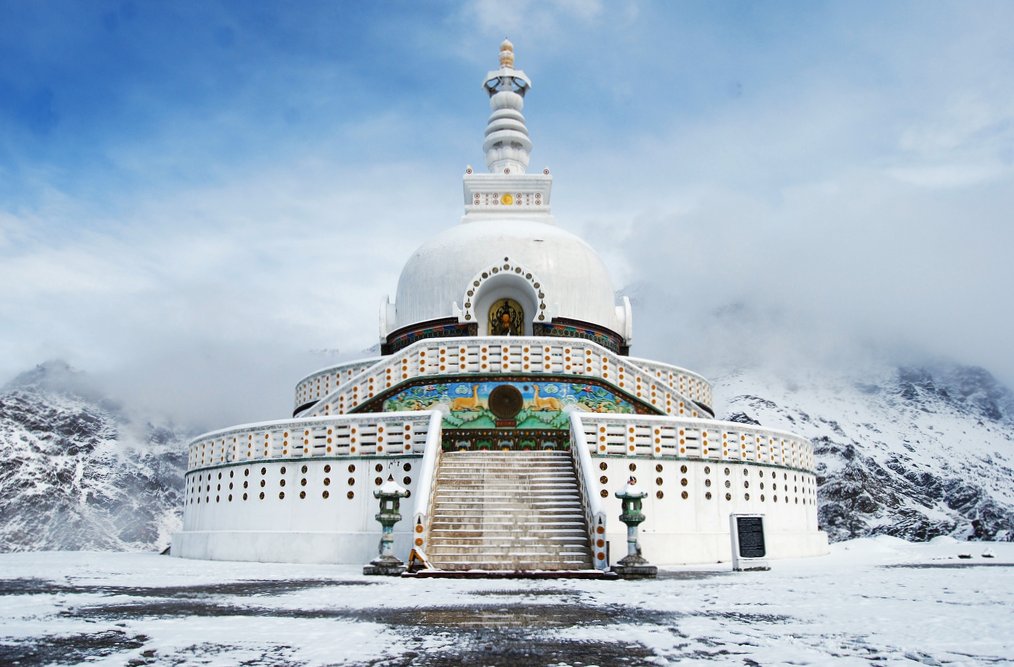 Photo: Vinay Goyal, Ludhiana · CC BY-SA 4.0 · Commons
A white peace stupa above Chanspa, completed in 1991 and reached by 555 steps or a road. Sunset lights the palace, the …
 Photo: Aksveer · CC BY-SA 4.0 · Commons
Leave Leh at 6 am for the 19 km drive to Thiksey, where monks gather for morning prayers on the roof and in the assembl…
Real prices
Local prices change with season and fuel costs. Check current status before you travel.
Getting there
Air
Leh airport is 4 km from town, with daily flights from Delhi (about 1 h 20 min) and services from Mumbai, Srinagar, Jammu and Chandigarh. Flights land in the morning. Pre-paid union taxis wait outside; ₹400–600 to most guesthouses.
Bus
HRTC runs Delhi–Leh and Manali–Leh buses in season, with a night halt at Keylong; Manali–Leh is roughly ₹900–1,000. From Srinagar, state buses run via Kargil. Timings and fares change, so check current status before you travel.
Road
From Srinagar ≈ 434 km over Zoji La, two days with a night in Kargil. From Manali ≈ 428 km via the Atal Tunnel and Tanglang La, usually two days with a night at Keylong or Jispa. Both roads close in winter.
Where to stay
Saver: the lanes of Changspa and Karzoo are full of family guesthouses at ₹1,200–2,500 a double, often with a garden and home-cooked dinner on request; Zostel Leh has dorms and private rooms near Karzoo. Comfort: Stok Palace Heritage Hotel, across the Indus, puts you in restored royal rooms or orchard villas, with a quieter village around you. Signature: The Grand Dragon Ladakh is the town's largest full-service hotel and is open all year, and in summer The Ultimate Travelling Camp's Chamba Camp faces Thiksey Monastery 19 km up the valley.
 Photo: Anirvan Shukla · CC BY-SA 3.0 · Commons
Budget
Zostel's Leh hostel offers dorm beds and private rooms within walking distance of Main Bazaar, with a common area …
 Photo: Bernard Gagnon Canon EOS REBEL T4i · CC BY-SA 4.0 · Commons
Mid
Rooms inside part of Stok Palace, the home of Ladakh's former royal family since the 19th century, and in the orch…
 Photo: Bernard Gagnon Canon EOS REBEL T4i · CC BY-SA 4.0 · Commons
Luxury
Leh's largest full-service hotel, open all year, with heated rooms, a restaurant serving Ladakhi and international…
Photo: Anirvan Shukla · CC BY-SA 3.0 · Commons
Luxury
The Ultimate Travelling Camp's summer camp near Thiksey Monastery, about 19 km up the Indus from Leh. Large furnis…
Trips that stop here
Photo: Anirvan Shukla · CC BY-SA 3.0 · Commons
Comfort
Private Ladakh Taxi Union SUV with driver
Photo: Anirvan Shukla · CC BY-SA 3.0 · Commons
Comfort
Private SUV with driver; local car in Padum where required
Photo: Anirvan Shukla · CC BY-SA 3.0 · Commons
Saver
State bus over Khardung La, shared taxis to Nubra and Pangong, local buses in the Indus valley
 Photo: Saurabh Lall · CC BY 2.0 · Commons
Saver
Shared Sumo taxis, state buses and local shared cars
Photo: Anirvan Shukla · CC BY-SA 3.0 · Commons
Signature
Private SUV with driver and a private naturalist guide
Photo: Anirvan Shukla · CC BY-SA 3.0 · Commons
Signature
Private SUV with driver and a private guide throughout
Questions
Plan three nights at the start of your trip and one at the end. The first two days are for rest and gentle walks while your body adjusts to 3,500 m; the third suits the palace, Shanti Stupa and an Indus valley monastery. A last night in Leh before your flight protects you from road delays on the way back from Nubra or Pangong.
Almost nothing. Check in, drink water, eat lightly and rest for most of the day. A short walk in Main Bazaar in the evening is fine. Skip alcohol, long hot showers and stairs if you feel breathless. Many visitors feel a mild headache on day one. Persistent headache, vomiting or breathlessness at rest need medical attention at SNM Hospital in Leh.
Yes. Flights operate all year and some hotels, including The Grand Dragon Ladakh, stay open. Many guesthouses and cafes close from November to March, pipes freeze and temperatures fall to about −15 °C at night. Winter suits the Chadar trek, snow leopard trips and festivals such as Losar and Dosmoche, but is not a casual holiday.
No. Prepaid connections issued outside Jammu and Kashmir and Ladakh do not work here. Postpaid Jio, Airtel and BSNL connections work in Leh town, and most guesthouses and cafes have Wi-Fi. Some travellers buy a local postpaid connection, which needs ID and a local address. Rules change, so check current status before you travel.
Union taxis wait outside arrivals with fixed fares, roughly ₹400–600 to most guesthouses in Changspa, Karzoo or the market area. App cabs do not operate in Ladakh. Many hotels arrange pickups for a similar fee. The drive is only 10–20 minutes, so do not walk with luggage on arrival.
Yes. Rental shops near Main Bazaar and Changspa rent Royal Enfields and Himalayans for roughly ₹1,500–2,500 a day plus fuel. Carry your licence and the bike papers. Local rules have limited rental bikes brought from outside Ladakh on some routes, so rent in Leh if you plan to ride locally, and check current status before you travel.
Yes, several banks have ATMs in and around Main Bazaar, and UPI works widely when the network is up. Withdraw enough cash in Leh for Nubra, Pangong, Turtuk and Tso Moriri, where many homestays and small shops accept cash only. In peak season the bazaar ATMs can run low by evening.
Changspa and Karzoo have the widest choice of family guesthouses at about ₹1,200–2,500 a double, many with gardens and simple home-cooked meals. Zostel Leh has dorm beds and private rooms. Stay within walking distance of Main Bazaar so you do not need taxis while you acclimatise, and ask whether hot water is solar or geyser.
Leh is generally relaxed and many women travel here alone. Guesthouse families look after their guests, and the main bazaar is busy until about 9 pm in summer. Use union taxis rather than lifts from strangers after dark, keep your guesthouse informed of day trips, and dress modestly at monasteries and in the old town.
Plan with a local planner
We reply within one working day with a route, a sleeping-altitude profile and an itemised price in your tier. Change anything. Pay nothing until you are sure.