Punakha Dzong sits at the confluence of the Pho Chhu and Mo Chhu, which makes it vulnerable to glacial lake outburst floods; floods damaged it in 1957, 1960 and 1994, and embankment works began in 2010.
Source: Punakha Dzong
Himalaya only · Saver trips from ₹7,500
Try "Spiti", "snow leopard", "Char Dham", "homestay", "Tiger's Nest"
Valley in Bhutan
The old capital where two rivers meet below the dzong
Punakha, at about 1,200 m and 72 km from Thimphu, was Bhutan's capital until 1955. Its dzong sits where the Pho Chhu and Mo Chhu meet, and its warm valley grows red and white rice. Spend one or two nights: the dzong, Chimi Lhakhang, the suspension bridge and the Khamsum Yulley Namgyal Chorten walk.
 Photo: Christopher J. Fynn · CC BY-SA 4.0 · Commons
Drop 1,900 m from Dochu La and the air changes: Punakha is warm in winter and hot in summer, with rice paddies, orange and papaya trees and jacaranda along the river. Its two rivers are named by gender. The Pho Chhu, the 'male river', comes down from glaciers in Lunana; the Mo Chhu, the 'female river', from the hills of Laya and Lingzhi. They join right below Punakha Dzong to form the Puna Tsang Chhu, which becomes the Sankosh in India.
The dzong was built in 1637–38 for the Zhabdrung, who lived and died here. It was the seat of government until 1955, the place where Ugyen Wangchuck was crowned first king in 1907, and is still where Bhutan's kings are crowned and married. In winter the Je Khenpo and the central monk body move down from Thimphu to its warm courtyards, and the Punakha Drubchen and Tshechu fill it in February or March.
The valley around it is farm country. Walk through mustard and rice fields to Chimi Lhakhang, the temple of the 'Divine Madman' Drukpa Kunley, where houses are painted with protective phalluses. Cross the long suspension bridge over the Pho Chhu, or hike up to the Khamsum Yulley Namgyal Chorten for a view up the river towards Gasa. Rafting runs on both rivers from spring to autumn.
The second-oldest and second-largest dzong in Bhutan, built in 1637–38, holds the remains of the Zhabdrung and the tertön Pema Lingpa. A covered wooden cantilever bridge, rebuilt in 2006–08 with a 55 m span, crosses the Mo Chhu to its gate.
Founded in 1499 on a round hillock near Lobesa, the temple of Drukpa Kunley is a pilgrimage for couples hoping for children. A 20-minute walk through rice and mustard fields leads up from Sopsokha village.
One of the longest suspension footbridges in Bhutan swings over the Pho Chhu upstream of the dzong, hung with prayer flags. Crossing it takes 5 minutes; it moves underfoot, so hold the railing.
A hilltop chorten built under the patronage of a queen mother, reached by a 45-minute climb through rice fields and pine from a suspension bridge. Its roof terrace looks up the Mo Chhu valley.
The valley floor of the Pho Chhu and Mo Chhu is Bhutan's rice bowl, growing both red and white rice. Ritsha village, with two-storey rammed-mud houses, is a typical farm settlement.
Field notes
Punakha Dzong sits at the confluence of the Pho Chhu and Mo Chhu, which makes it vulnerable to glacial lake outburst floods; floods damaged it in 1957, 1960 and 1994, and embankment works began in 2010.
Source: Punakha Dzong
The original covered cantilever bridge to Punakha Dzong was washed away by a flood in 1957 or 1958; a new one of traditional design with a 55 m free span was completed in 2008 with German help.
Source: Punakha
Pilgrims at Chimi Lhakhang can draw bamboo slips from the altar to choose a name for a child, and the lama blesses women with a wooden phallus said to have been brought from Tibet by Drukpa Kunley.
Source: Chimi Lhakhang
Experiences
 Photo: L Shyamal · CC BY-SA 3.0 · Commons
Cross the cantilever bridge over the Mo Chhu, walk through the three courtyards of Bhutan's most photographed dzong and…
 Photo: Bernard Gagnon · CC BY-SA 4.0 · Commons
A flat 20-minute walk from Sopsokha village through rice and mustard fields to the small yellow-roofed temple of Drukpa…
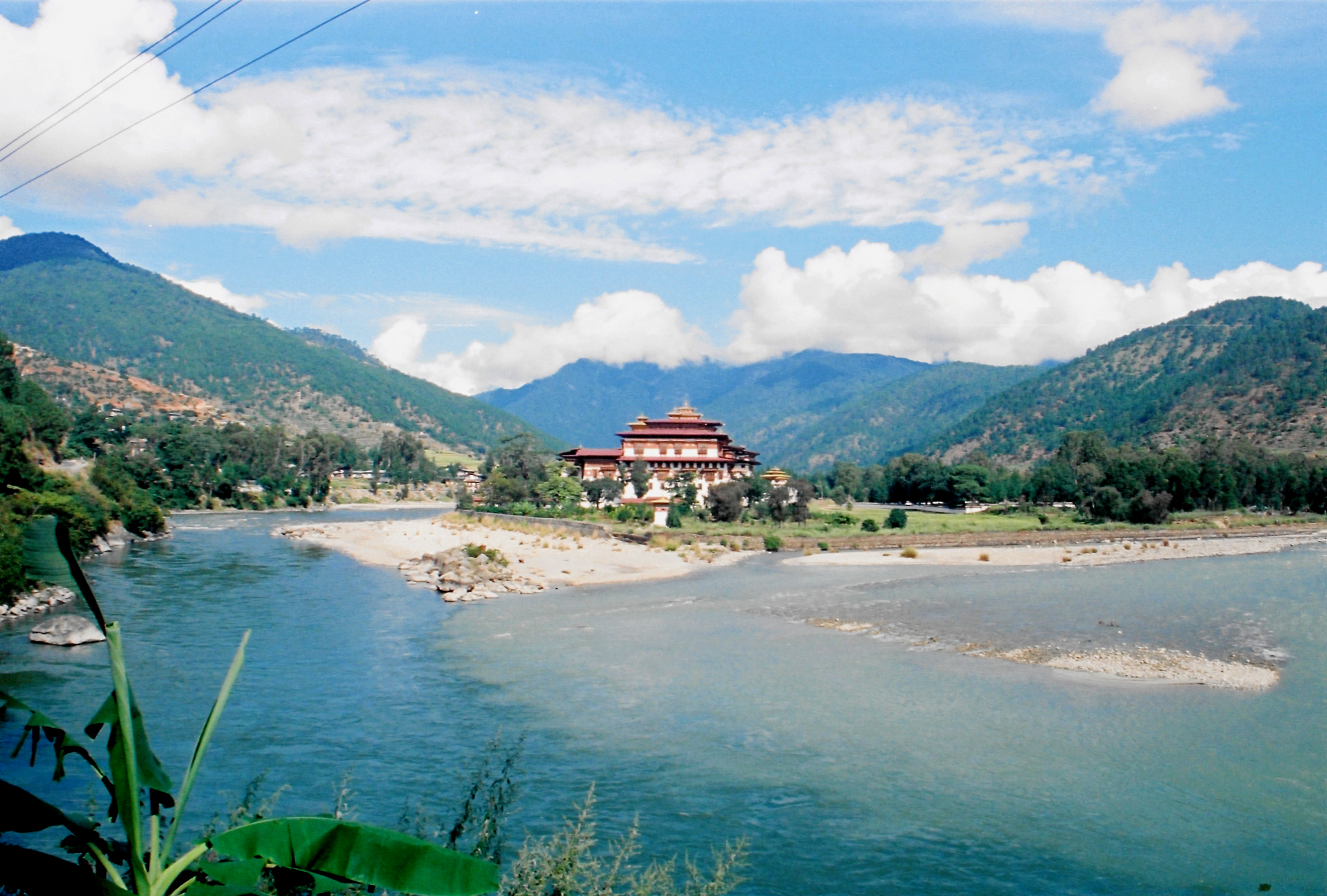 Photo: Taxidesign · CC BY 2.0 · Commons
A gentle grade II–III float down the Mo Chhu that ends in sight of Punakha Dzong. Suitable for first-timers and older c…
Real prices
Local prices change with season and fuel costs. Check current status before you travel.
Getting there
Air
Fly to Paro, then drive about 125 km and 4–4.5 hours via Thimphu and Dochu La. Most trips spend a night in Thimphu on the way.
Bus
Public buses run Thimphu–Punakha and Thimphu–Wangdue in about 3 hours. As a tourist you need your licensed guide with you beyond the first checkpoint, so ask your operator before planning a bus leg.
Road
Thimphu to Punakha is about 72 km and 2.5–3 hours over Dochu La at 3,100 m. Punakha to Phobjikha is about 80 km and 3 hours via Wangdue Phodrang and the Lawa La turn-off.
Where to stay
Saver travellers stay in simple hotels in Khuruthang, the new town 4 km south of the dzong, or near Lobesa, with doubles around ₹2,500–4,000. Comfort travellers choose riverside or hillside 3–4 star resorts along the Mo Chhu and above Lobesa. Signature options include Six Senses Punakha among rice terraces, COMO Uma Punakha on the Mo Chhu and Amankora Punakha, reached by a suspension bridge across the river through orange orchards.
Trips that stop here
 Photo: Christopher J. Fynn · CC BY-SA 3.0 · Commons
Comfort
Photo: Christopher J. Fynn · CC BY-SA 3.0 · Commons
Comfort
Private car with driver
Photo: Christopher J. Fynn · CC BY-SA 3.0 · Commons
Comfort
Private car with driver
 Photo: Afifa Afrin · CC BY-SA 3.0 · Commons
Saver
Photo: Afifa Afrin · CC BY-SA 3.0 · Commons
Saver
Shared jeep or bus to Jaigaon, then shared vehicle with licensed guide
Photo: Afifa Afrin · CC BY-SA 3.0 · Commons
Saver
Shared jeep or bus to Jaigaon, then shared vehicle with licensed guide
Photo: Christopher J. Fynn · CC BY-SA 3.0 · Commons
Signature
Private car with driver
Photo: Christopher J. Fynn · CC BY-SA 3.0 · Commons
Signature
Private car with driver
Questions
About 72 km, or 2.5–3 hours by car over Dochu La at 3,100 m. Most drivers stop at the pass for 30–45 minutes. Roadworks and winter frost can add time; check current status before you travel.
Yes. Day trips from Thimphu leave little time for the dzong, Chimi Lhakhang and the suspension bridge. One night is enough for the highlights; two nights lets you add rafting, the chorten hike and a slower village walk.
Warm. At about 1,200 m, Punakha sees 4–16 °C in January and 20–30 °C or more from May to September, with heavy monsoon rain in July and August. Winter is the most pleasant season and the reason the monk body moves here.
Yes, as we understand it. Punakha lies beyond Paro and Thimphu, so it must be listed on your entry permit, which your licensed operator arranges. You also need your licensed guide with you. Check current status before you travel.
The Punakha Drubchen, with its re-enactment of a 17th-century battle against Tibetan forces, is followed by the Punakha Tshechu, usually in February or March. In 2026 they were planned for 24 February to 1 March; the 2027 dates are tentatively mid-February. Check current status before you travel.
Very. It is warm, low, flat on the valley floor and has short walks, a suspension bridge children enjoy, gentle rafting and riverside picnic spots. Choose a hotel with a garden, and carry mosquito repellent in summer.
The dzong closes to visitors in the evening, but you can see it lit from the riverside road and from Khuruthang. Ask your driver to stop at the viewpoint on the Gasa road for a night photo.
For an Indian traveller sharing transport and a guide with three others, about ₹4,500–6,000: SDF ₹1,200, a simple hotel on twin share, local meals and monument fees. Add rafting if you want it.
There are bank branches and ATMs in Khuruthang and Lobesa, but do not rely on them working with foreign or Indian cards. Carry enough cash from Thimphu for fees, meals and small purchases.
Plan with a local planner
We reply within one working day with a route, a sleeping-altitude profile and an itemised price in your tier. Change anything. Pay nothing until you are sure.
